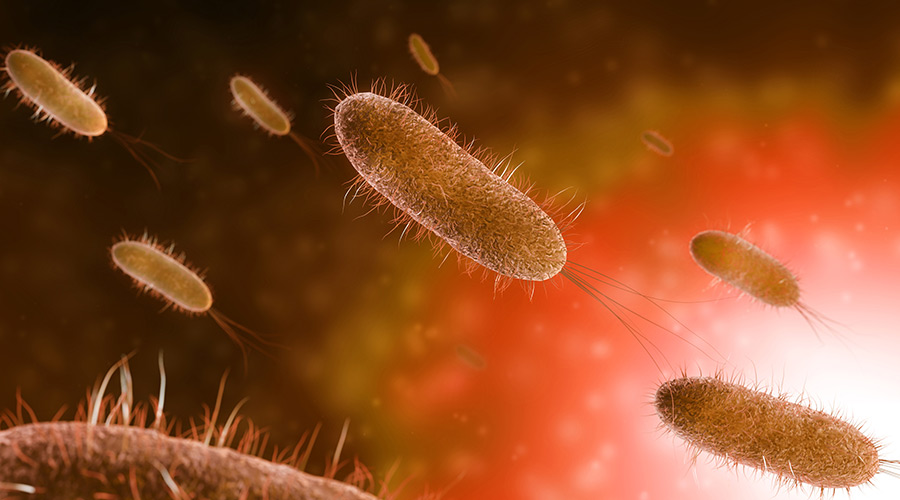
Interaction between Pseudomonas spp. and Listeria: mechanisms of cooperation within the same biofilm.
It is well established, based on numerous studies in the literature, that biofilm formation increases antimicrobial resistance in Pseudomonas spp.
The bacteria living within the biofilm are protected by the extracellular matrix, which shields them from exposure to antimicrobials.
This protection may promote the development of resistance and an increase in tolerance.
The properties of Pseudomonas spp. that facilitate their spread in food processing environments include several characteristics that make them particularly well-suited to survive and proliferate in these settings. These properties are:
Rapid growth at low temperatures
Pseudomonas spp. They are often psychrotrophic or psychrophilic, which means they can grow rapidly even at low temperatures, such as those typically found in food processing and storage environments.
This competitive advantage allows them to outcompete other bacteria and become dominant in refrigerated environments.
Tolerance to antimicrobial agents
Many species of Pseudomonas exhibit a high tolerance to various antimicrobial agents, including disinfectants and antibiotics.
This tolerance is due to the presence of multidrug efflux systems that expel toxic substances from the cells.
This characteristic allows them to survive and multiply even after cleaning and disinfection procedures.
Ability to form biofilms
Pseudomonas spp. They are efficient producers of biofilms, which are bacterial communities enclosed within a protective extracellular matrix.
Biofilms provide a refuge for bacteria, protecting them from disinfectants and other environmental stresses.
This ability facilitates the persistence of Pseudomonas in food processing environments.
Ubiquity
Pseudomonas spp. They are found in a wide variety of environments. This ubiquity means they can easily be introduced into and spread throughout food processing facilities.
Not demanding
Pseudomonas spp. They are not demanding, which means they can grow with minimal resources and under a variety of environmental conditions. This flexibility allows them to easily colonize new environments.
The ability to form biofilms, in particular, is a crucial property because it provides additional protection against disinfectants, allowing bacteria to survive and persist longer in these environments.
Their inherent tolerance to disinfectants, combined with their ability to form biofilms, not only helps them survive but can also promote the survival of other pathogens, such as Listeria monocytogenes, in food processing environments.
Pseudomonas spp. and Listeria monocytogenes
The biofilm formed by Pseudomonas spp. can significantly affect the survival of Listeria monocytogenes.
Here are the main ways this happens:
Physical protection
Pseudomonas spp. biofilms provide an extracellular matrix that acts as a protective barrier for L. monocytogenes.
This matrix protects bacteria from exposure to disinfectants and other antimicrobial agents, increasing their chances of survival.
Interspecific interactions
Interactions between Pseudomonas spp. and L. monocytogenes within the biofilm may facilitate the survival of the latter.
Multispecies biofilms can act as catalysts for horizontal gene transfer, facilitating the adaptation of L. monocytogenes to environmental conditions and reducing its susceptibility to antimicrobials.
Mountain hut
Pseudomonas-dominated biofilms can harbor and protect L. monocytogenes.
In a food processing environment, Pseudomonas biofilms can serve as reservoirs for L. monocytogenes, protecting it from cleaning and disinfection efforts.
Persistence
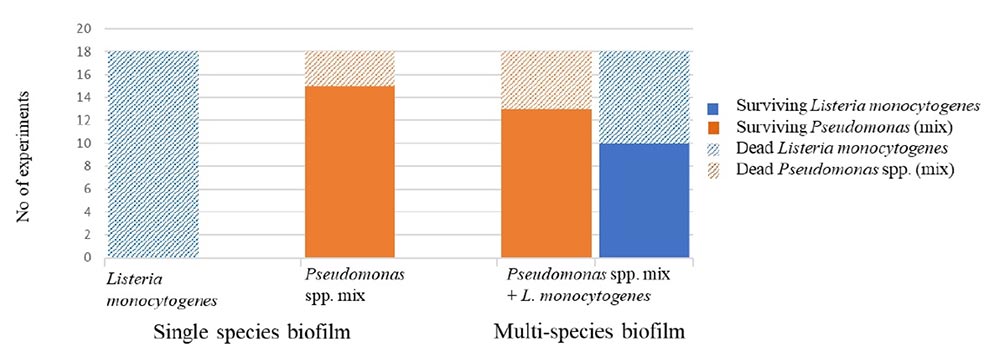
L. monocytogenes can persist within Pseudomonas biofilms, although in smaller numbers than its co-inhabitants.
Over time, L. monocytogenes can migrate into the innermost layers of the biofilm, where it is better protected from the disinfectant.
This helps it survive over time.
Regrowth
Although disinfection can reduce bacterial populations to undetectable levels, L. monocytogenes can resume growth within the Pseudomonas biofilm after 48–96 hours.
The results show that the combination of Pseudomonas spp. and L. monocytogenes regrew after disinfection, indicating that the Pseudomonas biofilm helped L. monocytogenes survive.
Pseudomonas spp.: Conclusions
In summary, Pseudomonas spp. biofilms not only increase their own tolerance to disinfectants but also create an environment that promotes the survival and persistence of L. monocytogenes, making cleaning and disinfection more difficult.
Thanks to the broad-spectrum and targeted action of Biorem® 3G in hydrolyzing the various components of the extrapolymere matrix of biofilms, it is possible to eliminate and reduce the risk of biofilm formation by these microorganisms.
Furthermore, the enzymatic approach does not promote the development of resistance and is able to bypass the tolerance mechanisms inherent in the matrix itself, ensuring greater effectiveness in removing biofilms from work environments.
The Piramide team specializes in applying customized enzymatic protocols tailored to specific production environments, and in developing pre- and post-treatment diagnostic strategies using state-of-the-art analytical methods.
If you found the article on Pseudomonas spp. and Listeria interesting, we recommend you also read these articles: