Microbial biofilms pose one of the most insidious threats to food safety in the meat industry, including cured meats, red meats, and processed products.
In such processing environments, biofilms are the dominant form of microbial life, accounting for 40% to 80% of all bacteria present.
These structures are not simply cellular aggregates, but sophisticated, self-organized ecosystems embedded in a matrix of extracellular polymeric substances (EPS) that facilitate survival under extreme industrial stress.
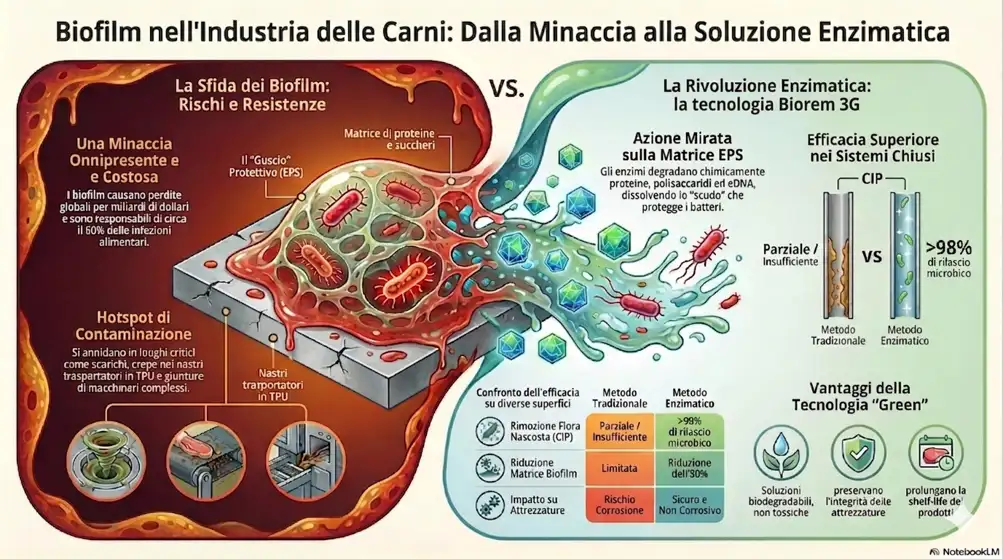
About 60% of foodborne illnesses are attributable to the transfer of pathogens from equipment surfaces to meat products. The economic impact is enormous, with annual losses in the billions due to product recalls, production shutdowns, and infrastructure deterioration.
What Are Biofilms and Why Do They Pose a Threat to Food Safety?
Biofilms form on critical surfaces such as stainless steel (SS304/316), food-grade plastic, and rubber, drastically reducing the effectiveness of sanitization protocols—in some cases by as much as 99%.
These consortium structures, composed of microbial communities embedded in a polymeric extracellular matrix (EPS) that can reach thicknesses of 100–500 μm, not only protect the microorganisms from environmental stress but also facilitate the transfer of antibiotic resistance and virulence genes, thereby increasing public health risks such as listeriosis and salmonellosis.
The economic consequences are equally severe: product recalls, production stoppages, and quality-related costs estimated at billions of euros annually worldwide, with a particularly high incidence in cured meat aging rooms, where relative humidity (RH 70–90%) and moderate temperatures (12–20°C) create ideal conditions for bacterial survival.
Specific Issues in the Meat Industry
The meat industry provides optimal conditions for biofilm formation due to operational cycles that alternate between high humidity, organic residues (fats, proteins, blood), and turbulent airflow, promoting both the initial adhesion and the mature growth of biofilm structures.
Conditioning films and adhesion to surfaces
Biofilm formation is accelerated by so-called “conditioning films”: residues of fats and proteins that alter industrial surfaces (stainless steel, polypropylene, or TPU), creating an ideal substrate for adhesion.
Biofilms in the Slaughter, Portioning, and Aging of Cured Meats
During slaughter and portioning, biofilms form on knives, tables, and conveyor belts, reaching densities of10⁸ CFU/cm² within 48–72 hours, with periodic shedding that spreads contaminants to subsequent batches.
In fermented and raw-cooked cured meats, such as salami and ham, the aging phase (months at 15°C and aw 0.85–0.92) selects biofilms that are resistant to lactic acid starter cultures and preservatives such as nitrites (E250 <150 mg/kg), where the reduced aw does not prevent the survival of psychrotrophic or opportunistic pathogens.
Systematic reviews from 2022–2025 document a 30–50% increase in cases of recurrent contamination attributed to persistent biofilms, with impacts on shelf life (an average reduction of 20–30 days), sensory alterations (off-flavors caused by volatile sulfur compounds such as H₂S and methanethiol), and health risks, including the formation of heterogeneous biofilms harboring both spoilage organisms and pathogens.
This dynamic complicates the implementation of EC Regulation 852/2004 on food hygiene, requiring proactive approaches that go beyond traditional HACCP plans.
Major Microorganisms in Meat Biofilms
Biofilms in the meat industry are multi-species ecosystems with a complex taxonomy, dominated by Gram-negative (50–70% of the biomass) and Gram-positive bacteria, as revealed by metagenomic studies of samples taken from steel surfaces.
Listeria, Salmonella, and E. coli: Pathogens That Form Biofilms
Among the main pathogens are Listeria monocytogenes (serotypes 1/2a and 4b, with flagellar motility that facilitates adhesion), Salmonella enterica (Typhimurium and Derby subtypes, which form biofilms on SS at 10°C), Escherichia coli O157:H7 (curli fimbriae for adhesion), and Staphylococcus aureus (producers of SEA-SEE enterotoxins).
16S rRNA-based analyses identify a stable microbiome: Proteobacteria (e.g., Pseudomonas fluorescens, 40%, producers of the siderophore pyocyanin), Firmicutes (35%, including spore-forming Clostridia), Actinobacteria (15%), and Bacteroidetes (10%), with diversity increasing as the biofilm ages.
This taxonomic diversity makes biofilms more resilient, with symbiotic interactions that involve the sharing of nutrients and virulence factors.
Critical Microorganisms and Production Hotspots
- Listeria monocytogenes: A classic psychrophile, the Listeria monocytogenes biofilm persists for years thanks to tolerance genes (lde, qacH) and lurks in floors, drains, and joints.
- Salmonella enterica: Particularly resilient in the poultry and swine supply chains, with multidrug-resistant (MDR) strains such as the Minnesota ST548 serovar that use biofilms to resist drying out.
Its ability to form biofilms on steel, ceramic, rubber, and plastic promotes its persistence in slaughter and processing environments.
Mixed Salmonella-Pseudomonas biofilms show significant tolerance to QACs, rendering standard protocols ineffective in the long term. - Escherichia coli (STEC): O157:H7 strains form robust biofilms on stainless steel and PVC, reaching high concentrations and exhibiting high tolerance to traditional disinfectants.
- Staphylococcus aureus and Campylobacter: They use meat proteins to strengthen their cell walls and resist acid and oxidative stress.
- Pseudomonas spp.—specifically P. fluorescens and P. aeruginosa—are the main psychrotrophic bacteria responsible for meat spoilage and the most abundant in food processing environments.
Although they are not primary human pathogens in food-related contexts, they play a key role in facilitating the persistence of other pathogens in mixed biofilms.
Pseudomonas aeruginosa has been identified as the most resistant microorganism in wet biofilms on polyurethane (TPU) belts, where it acts as a “shield” for other pathogens. - Acinetobacter: Together with Pseudomonas, it often acts as a “pioneer species,” creating a basal layer that facilitates the adhesion of other microorganisms.
Critical hotspots include porous surfaces such as thermoplastic polyurethane (TPU) conveyor belts, which are more difficult to sanitize than stainless steel. Other hotspots include slicer blades, meat grinders, unfinished gaskets, hard-to-reach corners of workbenches, and refrigeration systems prone to condensation.
Mechanisms of Biofilm Resistance to Disinfectants
The resistance of biofilms to sanitizers is multifactorial, involving a combination of physical, physiological, and genetic barriers that increase the MIC (minimum inhibitory concentration) by 10 to 1,000 times compared to the planktonic state.
The EPS matrix, which accounts for 80% of the volume, limits diffusion due to its negative electrical charge (anionic polysaccharides such as alginates) and chemical reactions (e.g., hypochlorite is neutralized by the amino groups of proteins that contribute to EPS formation), reducing the penetration of quaternary ammonium salts (QACs) by 90% at depths >1 mm. Quorum sensing (QS) mediated by autoinducers increases the expression of membrane proteins responsible for the efflux of disinfectants and induces EPS biosynthesis.
During the stationary or slow-growing phase, cells reduce their metabolism (low ATP), entering a VBNC state (vital but not culturable, 10–30% of the population, detectable only via PMA-qPCR), while persistent cells (1–5%) survive at concentrations 1,000 times the MIC. In cured meats, co-selection with nitrites induces cross-resistance.
In a biofilm that is only 7 days old, the hypochlorite dosage must be increased to concentrations >1000 ppm to achieve a reduction of >5 log, compared to the 50 ppm sufficient for the planktonic state.
Analytical methods: VBNC, qPCR, and metagenomics
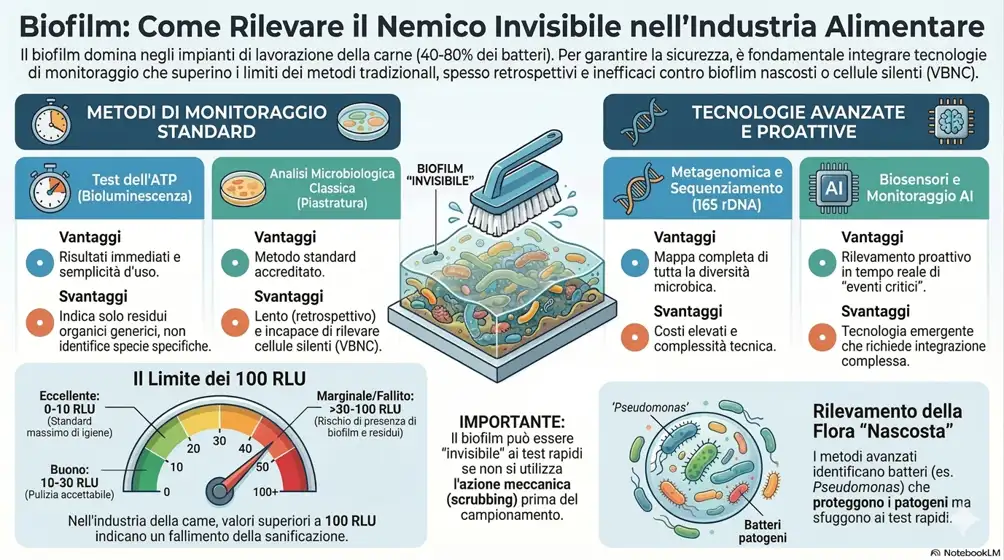
A critical challenge for technologists is the presence of VBNC (viable but non-cultivable) cells and persisters. These dormant populations survive aggressive sanitization and are not detected by standard microbiological plate tests, yet they retain their pathogenicity.
Accurate monitoring requires an integrated set of methods. Systematic reviews from 2024 emphasize hybrid approaches to overcome individual biases. Culture-based methods and ATP-based assays underestimate VBNC by 50%, providing data only on the total viable load.
Scanning electron microscopy (SEM) and confocal laser scanning microscopy (CLSM) can visualize 3D structures, EPS fibrils, and microcolonies, but they are difficult to apply in an industrial setting.
Molecular techniques, including qPCR and metagenomics (16S rRNA), are essential for mapping actual reservoirs of contamination.
The latter represents the most promising approach, as it allows for the mapping of the entire microbiome of the production environment, identifying resistant reservoirs and pioneer species that cannot be detected using culture-based methods.
Control Methods
Conventional methods (QAC 1000 ppm/10 min, PAA 200 ppm at pH 3.5, gaseous ozone 2–5 ppm) achieve a 2–4-log reduction in young biofilms but fail on mature ones (>7 days), requiring much higher doses that are not always sufficient.
Enzymatic approaches are emerging as a clean-label solution, selectively breaking down EPS to then expose the cells to subsequent sanitizers.
Proteases hydrolyze peptide bonds, increasing permeability by 70% and reducing matrix cohesion; DNases fragment structural eDNA (60% reduction in integrity); combining them with amylases, cellulases, and lipases makes the enzyme cocktail extremely effective.
Recently, the role of Dispersin has also been studied; this enzyme is capable of hydrolyzing the beta-(1,6)-PNAG bond, thereby very effectively degrading the EPS matrix, particularly in mature biofilms associated with pathogens such as E. coli, S. aureus, and L.
How to Remove and Prevent Biofilm from Surfaces: The Enzymatic Approach
Piramide’s solution for combating biofilms—the BIOREM® line , now in its third generation—also incorporates this enzymatic activity!
Sequential protocols (enzymatic pretreatment + rinsing + PAA) are effective against Listeria biofilms, reducing the residual bacterial load by more than 6 log, with the advantage of not causing selective resistance.
Managing biofilms in the meat industry today requires a true paradigm shift: it is no longer enough simply to “clean”; rather, it is essential to understand and manage the microbial ecology of production surfaces.
Only by combining mandatory mechanical measures with advanced enzymatic technologies and monitoring tools based on metagenomic analysis will it be possible to develop truly preventive strategies and ensure a more robust, modern, and sustainable level of food safety.
With advanced services such as SMARTBIOME™, bioMérieux now makes it possible to take microbiological risk management a step further: no longer limited to simply searching for known pathogens, but rather understanding the true microbiome of production environments and the samples being analyzed.
Thanks to metagenomic analysis, it is now possible to identify “spoiler” microorganisms, persistent species, and microbial communities that cannot be detected using traditional culture-based methods, thereby transforming complex microbiological data into clear and actionable information.
The goal is to help food companies identify the root causes of contamination, prevent such incidents from recurring, and enhance the reliability of the production process, thereby reducing financial risks, product recalls, and shelf-life losses.
Understanding the actual ecology of surfaces and the microbiome associated with biofilms is now one of the most promising ways to overcome the limitations of traditional microbiological testing and develop truly preventive sanitization strategies.
Piramide’s Biorem® 3G: the octavalent enzyme cocktail
For this reason, Piramide—thanks to the ongoing work of Realco’s R&D department—is able to offer Biorem®, an enzymatic solution specifically designed to:
- Contain enzymes belonging to multiple enzyme classes, and thus targeting different molecular targets
- Containing enzymes with high substrate specificity
- Contain enzymes with high activity
These factors are extremely important to consider whenever evaluating an enzymatic approach for the removal of biofilm—or, more precisely, its amorphous matrix. Products that are deficient in enzyme classes, lack specificity, and have low activity can lead to mediocre results.
Biorem® 3G is the only octavalent enzyme blend on the market capable of hydrolyzing the maximum number of components in the organic matrix of biofilms, making it the most effective solution, especially for deeply rooted and resistant biofilms.
Thanks to the broad-spectrum and targeted action of Biorem® 3G in hydrolyzing the various components of the extrapolymere matrix of biofilms, it is possible to eliminate and reduce the risk of biofilm formation by these microorganisms. Furthermore, the enzymatic approach does not promote the development of resistance and is able to bypass the tolerance mechanisms provided by the matrix itself, ensuring greater effectiveness in removing biofilms from work environments.
The Piramide team specializes in applying customized enzymatic protocols tailored to specific production environments, and in developing pre- and post-treatment diagnostic strategies using state-of-the-art analytical methods.
Bibliography
- Targeting Biofilm Resistance in Meat Production (2025): PMC12805358
- Control of Bacterial Biofilms in Red Meat – Systematic Review (2022): S0309174022001383
- Systematic Evaluation of Biofilm Detection (2024): PMC11509713
- Ongoing Issues with Biofilm in Meat (2024): PMC11536009
Contact us for advice or a treatment plan:
Email: info@piramide-ambiente.it or Phone: 0332-826017
Biofilms in the Meat and Deli Products Industry: FAQs
A biofilm is a community of microorganisms attached to a surface and enclosed in a matrix of extracellular polymeric substances (EPS) that protects them.
In meat-processing environments, it represents the dominant form of bacterial life (40–80% of the total) and is responsible for approximately 60% of contamination, as it transfers pathogens from equipment to products.
The main ones are Listeria monocytogenes, which persists for years in drains and joints; Salmonella enterica (the Salmonella biofilm survives on steel, rubber, and plastic even at low temperatures); Escherichia coli O157:H7; and Staphylococcus aureus.
Pseudomonas and Acinetobacter act as “pioneer species,” creating the layer that promotes the adhesion of other pathogens.
Traditional sanitizers penetrate mature biofilms only to a limited extent because the EPS matrix blocks their diffusion.
The most effective approach is enzymatic: specific enzymes (proteases, DNases, dispersins, etc.) degrade the matrix and expose the cells to the subsequent sanitizer.
A sequential protocol (enzymatic pretreatment + rinsing + peracetic acid) reduces the Listeria load by more than 6 log. Piramide’s Biorem® enzymatic product line is designed for this purpose.
We need a paradigm shift: simply “cleaning” isn’t enough; we need to manage the microbial ecology of surfaces.
This involves combining mechanical action, enzymatic sanitization that does not promote resistance, and monitoring based on metagenomic analysis to identify sources of contamination, while integrating the HACCP system required by EC Regulation 852/2004.
Piramide develops customized enzymatic protocols with pre- and post-treatment diagnostics.
There are suppliers that specialize in industrial cleaning; In the field of enzymatic cleaning, Piramide has been operating for over 30 years as the exclusive distributor in Italy for Realco, offering the third-generation Biorem® line (Biorem® 3G), an octavalent enzymatic blend designed to hydrolyze the matrix of even the most deeply rooted biofilms.
The company supports its customers with consulting services, customized protocols, and advanced analytical monitoring.