In this article, we discuss contaminated milk and the relationship between the presence of Bacillaceae and UHT products, a connection that has been known since these bacteria were first isolated in UHT milk.
UHT milk, produced by subjecting milk to a minimum heat treatment of 135°C for 1 second (though it is typically treated at temperatures between 135°C and 150°C for 1–8 seconds in a continuous flow) followed by immediate aseptic packaging in pre-sterilized containers, is virtually and commercially sterile because the heat treatment inactivates vegetative bacterial forms and their spores.
After pasteurization, UHT milk is stored at room temperature. According to European standards, this type of packaged milk may contain fewer than 10 CFU/mL of bacterial cells after incubation at 30°C for 15 days.
Contamination of milk can sometimes occur as a result of recontamination during the filling of containers, and/or is caused by the proteolytic and lipolytic activity of thermophilic spore-forming bacteria present in milk and dairy products (e.g., powdered milk).
Thermophilic bacilli are cultured in the laboratory on plates of nutrient medium for aerobes (PLA or APC agar) incubated at 55°C.
Distinction between spore-forming bacterial strains
The spore-forming bacteria isolated in this manner from UHT milk can be divided into two categories:
- a) obligate thermophiles and
- b) facultative thermophiles, also known as thermotolerant organisms (Burgess et al. 2010)
Obligate thermophiles grow only at high temperatures (between 40° and 70°C) and include the species Anoxybacillus flavitermus and Geobacillus spp. (Flint et al. 2001; Scott et al. 2007).
Facultative thermophilic spore-forming bacteria belong to the genus Bacillus and grow at temperatures typical of mesophilic and thermophilic bacteria, depending on the species. Some examples of these meso/thermophilic spore-forming bacteria are B. licheneformis, B. coagulans, B. pumilus, B. sporothermophilus, and B. subtilis. (Burgess et al., 2010).
The main characteristics of thermophilic bacilli are:
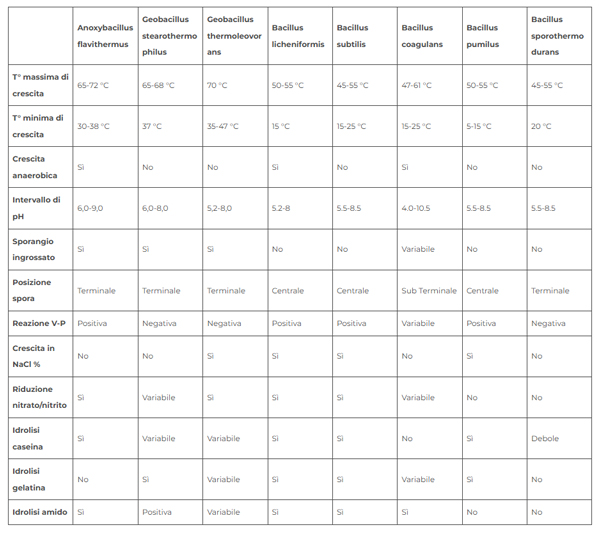
- Maximum growth temperature: 45°–70°C
- minimum growth temperature 30–47°C
- pH range for growth: 5.2–9.0
- degradation of casein by most strains
- starch breakdown by most strains
Many strains produce enzymes or other metabolic products that cause odors and structural defects.
Contaminated milk: sources of contamination
The source of spore-forming bacteria can be traced to barns or milk pasteurization facilities. In barns, the floor is the primary habitat for spore-forming bacteria; contaminated forage and bedding contaminate the teats and udders of cattle, and from there the bacteria enter the milk through th
.
Milk can therefore be subject to cross-contamination from silage of poor microbial quality, in which spore-forming bacteria may be present at levels of 100–1,000 CFU/mL.
Dirty milking machines can also be sources of contamination, as can unhygienic practices by milking personnel.
As for their presence in milk processing plants, they can be found in pre-pasteurizers, preheaters, evaporators, and other parts of the plant in the form of biofilms (Scott et al., 20).
Characteristics of thermophilic bacilli
Members of the genus Bacillus and obligate thermophilic bacilli have simple nutritional requirements: they do not require specific amino acids for growth and, therefore, are able to grow in simple media (e.g., TSA).
The growth temperature of obligate thermophiles is usually between 55°C and 65°C, varying among species and individual strains of the same species.
For facultative thermophilic Bacilli, the growth temperatures are listed in Table 1.
The main species of obligate thermophiles are:
- Anoxybacillus flavithermus
- Geobacillus sterothermophilus
- Geobacillus thermoleovorans
Table 1 lists the characteristics of facultative and obligate thermophilic bacilli
The genus Geobacillus
The genus comprises at least 19 different species, with rod-shaped cells that occur singly or in short chains and are motile via peritrichous flagella.
Species of Geobacillus belong to the genus Geobacillus, family Bacilaceae, order Bacillales, class Bacilli, and phylum Firmicutes.
They are Gram-positive, but their staining may vary to the point of appearing Gram-negative. They are chemoorganotrophic bacteria, either aerobic or facultative anaerobic. They are obligate thermophilic strains. Growth temperatures range from 37° to 75° C, with the optimal growth range between 55° and 65° C. Growth occurs at pH levels between 6.0 and 6.5.
Identification tests require an assessment of their activity with respect to carbohydrates. Geobacilli produce acid but no gas from glucose, fructose, maltose, mannose, and sucrose. Many species do not produce acid from lactose.
Metabolic characteristics of Geobacillus stearothermophilus
In addition to the characteristics listed above, strains of this species ferment glycerol and mannose, but not lactose or galactose. Sporulation is a key characteristic of this species. It is promoted by the presence of sulfate and manganese chloride in the growth medium.
It is produced in 10 days in a substrate with a pH of 6–8.9. G. stearothermophilus is used for the production of various enzymes, such as alpha-amylases resistant to 100°C for 1 hour, thermostable beta-mannase, thermostable extracellular alkaline protease, alpha-L-arabinofuranosidase, thermostable lipase, and beta-xylosidase.
This microorganism is responsible for the spoilage known as “flat sour” or souring without gas production. Its spores can be found not only in UHT milk but also in concentrated skim milk and powdered milk.
Characteristics of Geobacillus thermoleovorans
In addition to the characteristics mentioned above, colonies grow in culture media that are white and often cream-colored, with a wrinkled surface. It produces acid from cellobiose, melobiose, lactose (not all strains), raffinose, sucrose, and trehalose. It does not break down other sugars (Dinsdale et al., 2011)
Characteristics of Anoxybacillus flavithermus
Anoxybacillus flavithermus belongs to the genus Anoxybacillus (18 species), the family Bacillaceae, the order Bacillales, the class Bacilli, and the phylum Firmicutes.
In addition to the characteristics listed above, this strain is positive for catalase and oxidase. It utilizes glucose, mannose, maltose, sucrose, arabinose, rhamnose, and sorbitol. It does not grow at 68°C (Pitula et al. 2000, Burgess et al. 2010).
Bacillus sporothermodurans and other heat-resistant spore-forming bacilli in UHT milk
UHT milk may contain certain species of spore-forming bacilli resistant to high temperatures, such as Bacillus cereus, B. sphaericus, B. licheneformis, Brevibacillus brevis, and two other species with a strong spoilage potential: B. sporothermodurans and Paenibacillus lactis. B. sporothermodurans was described by Pettersson et al. (1996). The main characteristics of the bacillus are listed in Table 1.
Its spores, which can withstand temperatures of 140°C for a few seconds, have been isolated from various milk-based products (cream, chocolate milk, powdered milk, and reconstituted milk) (Hammer et al. 2000) that were spoiled following spore germination and the multiplication of vegetative forms.
The species B. sporothermodurans is genetically heterogeneous, comprising different clones that can be grouped into three groups: I, II, and III. The first group consists of 16 strains, while groups II and III each contain 3 strains.
Strains for growth require the presence of vitamin B12 in the culture medium. Colonies on BHI agar appear flat, circular, and intact, with a beige or cream color. They produce acid from glucose, D-fructose, and maltose, and small amounts from sucrose and trehalose.
Brevibacillus brevis
Brevibacillus species are Gram-positive, motile rods with peritrichous flagella. They produce ellipsoidal spores within swollen sporangia. The colonies are flat, smooth, circular, and intact. They are strict aerobes, catalase-positive, and oxidase-negative. They hydrolyze casein, gelatin, and DNA but not starch or urea.
They grow at a pH of 5.5–5.6. Their growth is inhibited by 2% NaCl. The optimal growth temperature is 30 °C, the minimum is 20 °C, and the maximum is 50 °C. They produce acids but no gas from D-fructose. Acid production, however, varies depending on the substrate, such as D-glucose, maltose, and D-ribose. They do not break down other sugars (Shida et al. 1995)
Paenibacillus lactis
P. lactis was isolated from raw milk and UHT milk by Schedelman et al. (2004). One of the main sources of contamination appears to be animal feed. The spores are resistant to temperatures of 120 °C.
Colonies develop on TSA within four days and appear opaque, cream-colored, slightly convex, round, with jagged and translucent edges. The mobile microcolonies spread across the surface of the agar in a clockwise direction.
They are aerobic. The maximum growth temperature is between 50° and 55°C, while the optimal temperature is between 30° and 40°C. The optimal pH for growth is 7; the minimum pH is between 5.0 and 6.0, and the highest pH at which growth occurs is between 10.5 and 11. The bacilli do not hydrolyze casein, but they do break down beta-D-galactopyranoside.
The bacilli produce acid from L-arabinose, D-cellobiose, D-fructose, D-glucose, glycogen, lactose, maltose, mannitol, D-mannose, D-melibiose, D-raffinose, ribose, starch, sucrose, and D-trehalose.
Acid production is strain-dependent for D-arabinoside; L-strains of Paenibacillus lactis belong to the genus Paenibacillus, family Paenibacillaceae, order Bacillales, class Bacilli, and phylum Firmicutes.
Potential pathogenicity of obligate thermophilic bacilli and facultative thermophiles
Strains of obligate and facultative thermophiles produce organic acids and various heat-stable enzymes, such as proteases and lipases, thereby altering milk and dairy products.
Obligate thermophiles have a low spoilage potential because milk and dairy products are stored at temperatures below 37°C, at which they do not grow. Facultative thermophile strains, on the other hand, are more likely to cause spoilage.
The changes they cause are listed in Table 2
| ALTERATION | RESPONSIBLE AGENTS |
| Souring | Bacillus spp., Bacillus coagulans |
| Gentle coagulation | Bacillus spp., Geobacillus stearothemophilus, Paenibacillus lactis |
| Bulging of the container | Bacillus spp. |
| Viscosity | Bacillus subtilis, Bacillus licheniformis |
| Unpleasant odors and tastes | B. cereus |
Obligate thermophiles are not pathogenic. Some thermophiles, such as B. licheneformis, B. pumilus, and B. subtilis, can produce toxins, but only at 30°C and 37°C (De Jonge et al. 2009); B. cereus is capable of spoiling milk, rendering it undrinkable.
Contaminated milk: heat resistance of thermophilic spores
Table 3 lists the heat resistance of the spores of obligate and facultative thermophiles
| °C | Survival | |
| Geobacillus sporothermophilus | 121°C | 42 seconds |
| 143°C | 4 sec | |
| Anoxybacillus flavithermus | 143 °C | 3 sec |
| Bacillus licheneformis | 120 °C | 3 sec |
| 125°C | 4 sec | |
| Bacillus subtilis | 120°C | 4 sec |
| Bacillus pumilus | 135°C | 10 sec |
| Bacillus sporothermodurans | 125°C | 2 sec |
The presence of thermophiles in milk and biofilms as sources of contamination
The number of thermophilic bacteria in milk is generally less than 10 cfu/ml (Hill et al. 1994; Guiggon et al. 2002), and concentrations exceeding 100 cfu/ml have been observed only on rare occasions. The predominant thermophiles are B. licheneformis and B. coagulans, but in UHT milk only G. sporothermophilus and A. flavithermus are present.
Thermophilic bacteria in pasteurization plants may be found in biofilms. The adhesion of bacteria to surfaces and their subsequent growth into biofilms is a common occurrence in natural environments and industrial plants.
Biofilms are defined as microcolonies of bacterial cells enclosed in an extracellular matrix of polymeric substances (EPS) that develop rapidly on surfaces.
Biofilm formation occurs in three stages:
Phase I (within 1–10 seconds) on surfaces coated with milk proteins and calcium phosphate
Phase II (within 6–8 hours) involves the initial colonization of the substrate by bacterial cells, accompanied by the formation of exopolysaccharides that support the process
Phase III: Irreversible stabilization of the biofilms occurs. These are mature biofilms in which bacterial cells are embedded within channels in the organic matrix. Biofilm formation occurs in parts of the plant where temperatures range from 45° to 65°C. Bacteria are released from these formations and then enter the milk stream.
Biorem®, an effective solution for eliminating and controlling biofilm formation
Based on what has been discussed so far, it is clear that the biofilm-forming potential of biofilm-forming microorganisms represents an additional risk factor in ensuring the appropriate shelf life of UHT milk, as well as other products treated at high temperatures.
Biorem® 3G, thanks to its exclusive, patented enzymatic formulation for the removal of microbial biofilm, represents an effective solution for completely removing any biofilm, regardless of its stage of development and microbial composition.
Piramide has a track record of success in applying Biorem® treatment protocols to UHT systems.
If you are interested in learning more about how Piramide can help you understand, resolve, and manage similar issues in your company, please contact us to request an audit with our technical experts in enzymatic cleaning procedures and microbiology.
Bibliography
- Burgess A; Lindsay D.; Flint S.H. et al. (2010) Int. J. Food Microbiol. 144, 215–225
- Coorevits, A.; Dinsdale, A.; Halket, G. et al. (2012) Int. J. Syst. Evol. Microbiol. 62, 1470–1485
- De Jonghe V; Coorevitz A; De Block J. et al. (2010) Int. J. Food Microbiol. 136, 318-325
- Griffith, M.W. (1955) Bulletin of the International Dairy Federation 302,3-6
- Pikuta E.; Lisenko A.M.; Chuvilakage N. et al. (2002) Int. J. Syst. Evol. Microbiol. 53, 2019-2017
- Schedelman, P.; Pi, L.A.; Herman, L.; De Vos, P., et al. (2005) *Appl. Environ. Microbiol.* 71, 1480–1494