
Over the past decade, microbiological quality management in winemaking has undergone a radical transformation driven by the need to understand not only which microorganisms are present in the winery system, but above all how they interact with surfaces and persist despite conventional sanitization protocols.
For a Quality Manager working in the food, Beverage, or Pharmaceutical sectors, the concept of “cleanliness” has evolved to a molecular level, where the main enemy is no longer represented exclusively by suspended microbial cells (planktonic state), but by highly organized sessile communities known as biofilms.1
In the wine industry, where the porosity of oak barrels coexists with the precision of stainless steel, the biofilm in the cellar acts as a reservoir of latent contamination, capable of periodically releasing spoilage agents such as Brettanomyces bruxellensis or acetic acid bacteria.3
The challenge is not only technical but also economic, since even a single deviation in sensory characteristics can compromise entire batches of high-quality products.
In this context, Piramide Ambiente proposes an approach based on enzymatic biotechnology, overcoming the limitations of traditional chemistry to offer targeted eradication solutions that preserve the integrity of the equipment and ensure the sustainability of the process.5
Microbial Ecology and Taxonomy of Biofilms in Wineries
The cellar microbiota is not a static entity, but rather a complex ecosystem that extends from the grapes all the way to the bottling lines.
The ability to form biofilms is a universal survival strategy that allows microorganisms to withstand hostile environmental conditions, including an extremely low pH (3.0–3.8), high concentrations of ethanol (> 14%), and the presence of antimicrobial agents such as sulfur dioxide (SO₂).7
Off-Flavor Yeasts: Brettanomyces in Wine and the Dominance of B. bruxellensis
Among yeasts, the genus Dekkera/Brettanomyces poses the most insidious threat to the stability of red wines aged in wood. Brettanomyces bruxellensis possesses superior bioadhesive properties, facilitated by the production of cell wall proteins (adhesins) that allow it to initially anchor itself to stainless steel, polystyrene, and, particularly effectively, to wood fibers.9
Once it has established a bond with the surface, B. bruxellensis begins synthesizing an extracellular matrix that envelops the cells, protecting them from treatment with lactic acid or alkaline detergents.10
It has been shown that Brettanomyces cells within a biofilm can survive in a “viable but non-culturable” (VBNC) state even after seemingly effective washing cycles, rendering detection by conventional plate culture methods ineffective.7
Lactic Acid Bacteria (LAB) and the Ambivalence of Oenococcus oeni
Lactic acid bacteria play a dual role in the wine industry. While Oenococcus oeni is essential for malolactic fermentation (MLF), its ability to form biofilms on oak chips and tank walls can make it difficult to control fermentation kinetics.13
O. oeni cells organized into biofilms exhibit significantly greater resistance to ethanol stress than planktonic cells, maintaining high metabolic activity even under conditions of nutrient deprivation.14
However, genera such as Lactobacillus and Pediococcus are responsible for serious structural and aromatic alterations. Pediococcus spp., in particular, is known for producing glucan-based exopolysaccharides (EPS) that give the wine a viscous, “stringy” texture—a defect directly related to the bacterium’s biofilm-forming nature.15
Acetic Acid Bacteria in Wine (AAB): Persistence at the Air-Liquid Interface and Acetosis
Acetic acid bacteria (AAB), notably the genera Acetobacter and Gluconobacter, are strictly aerobic microorganisms that colonize the upper portions of the tanks and the fill lines.15
They form film-like biofilms (veils) at the air-wine interface, using atmospheric oxygen to oxidize ethanol into acetic acid (wine acescentation).14
The difficulty in treating these biofilms lies in their location in areas that are often hard to reach with traditional CIP (Cleaning-In-Place) systems, such as vent valves and top door gaskets.3
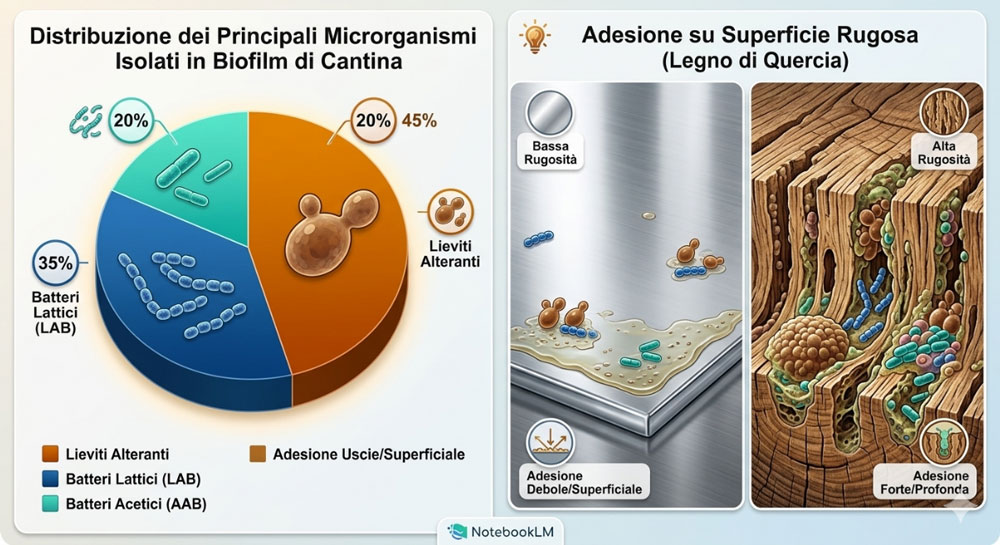
| Microbial Group | Predominant Species | Surface Type | Impact on Quality |
| Leavening Agents | B. bruxellensis, Pichia spp. | Wood, Steel, Pipes | Volatile phenols, Surface films |
| Lactic Acid Bacteria | O. oeni, Pediococcus, Lactobacillus | Tanks, Heat Exchangers | Early MLF, Smooth, Mousse-like Texture |
| Acetic Acid Bacteria | Acetobacter aceti, Gluconobacter | Valves, Faucets, Veils | Volatile Acidity (Acidity) |
| Mold and Fungi | Aspergillus, Penicillium | Cellar Walls, Moisture | Mycotoxins, Musty Odors |
How Biofilm Forms in the Winery: Mechanisms and Chemical Resistance
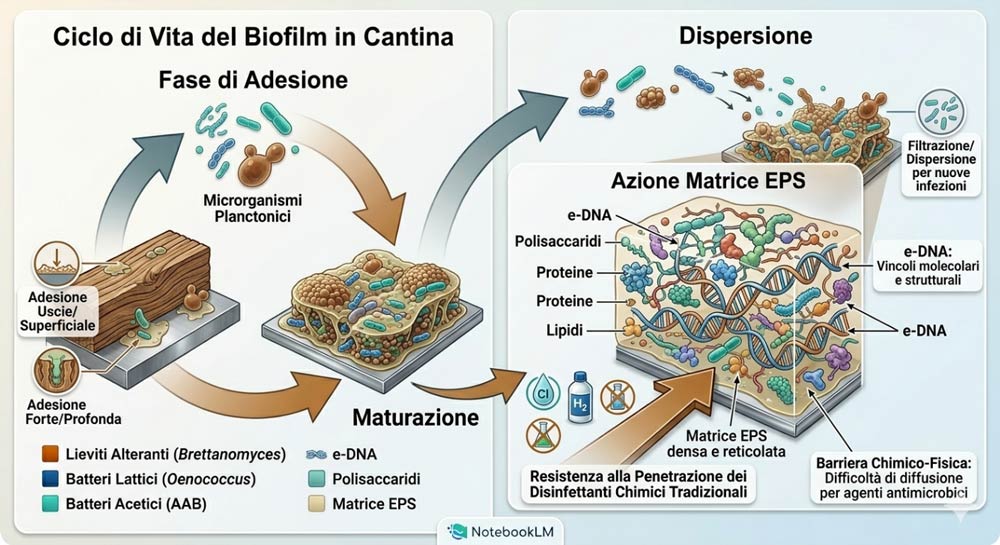
Understanding the biofilm life cycle is essential for developing effective treatment protocols. The process consists of four sequential stages: initial (reversible) adhesion, permanent adhesion, maturation (EPS production), and dispersal.1
The Extracellular Matrix: A Molecular Shield
The real obstacle to sanitization is not the microbial cell itself, but the organic matrix that surrounds it. Composed of a mixture of polysaccharides, proteins, lipids, and extracellular DNA (eDNA), the matrix acts as a physical and chemical barrier.1
- Limited Penetration: Many disinfectants, such as chlorine or peracetic acid, are consumed by oxidation of the surface layers of the matrix before they can reach the underlying viable cells.4
- Mechanical Protection: The matrix firmly anchors the microbial community to the surface, resisting the shear forces of high-pressure wash streams.2
- e-DNA and Cohesion: Recent studies have identified extracellular DNA as a key structural component that confers mechanical stability and facilitates the exchange of resistance genes among different microbial species within the same biofilm.6
Surfaces and Roughness: Stainless Steel Tanks Are Not Immune to Biofilm
Although stainless steel is the material of choice for hygiene, it still has micro-imperfections, welds, and areas of galvanic corrosion that provide a haven for microorganisms.3
In wineries, the risk is exacerbated by the presence of organic residues (tartrates, proteins, polyphenols) that act as surface modifiers, facilitating microbial attachment.1
In this scenario, washing with caustic soda can remove visible residues but leave the basal layer of the biofilm intact, allowing for complete recolonization within a few hours.5
Enzymatic Sanitization Against Biofilm in the Winery: BIOREM® 3G
The traditional approach, which relies on aggressive chemicals (alkaline detergents and oxidizing disinfectants), often has insurmountable limitations when treating mature or layered biofilms.
The enzymes contained in the BIOREM® product line, on the other hand, offer a targeted action that does not aim to indiscriminately kill the cells, but rather to dismantle the matrix that protects them.17
Biocatalysis: The Active Ingredient in Enzymatic Cleaning
Enzymes are highly specialized proteins that act as biological catalysts, accelerating the breakdown of chemical bonds within the biofilm matrix. Unlike caustic soda, which acts through nonspecific erosion, an enzymatic cocktail is designed to target key structural components 6:
- Polysaccharidases (e.g., glucanases): They hydrolyze the glycosidic bonds of sugar polymers (EPS), breaking down the bulk of the biofilm.21
- Proteases: They break down the protein chains that anchor the biofilm to the surface and those that maintain structural integrity between cells.6
- Nuclease (DNase): One of the most recent innovations, designed to hydrolyze e-DNA, thereby removing the “cement” that holds the biofilm together.5
The Octavalent Solution: BIOREM® 3G
Piramide SRL offers BIOREM® 3G technology, a patented enzyme blend that combines eight different enzymatic activities.6
This formulation is specifically optimized for:
- Hydrolyzing PNAG (Poly-N-acetylglucosamine): one of the most common and resistant exopolysaccharides in bacterial and fungal biofilms.6
- Operating at Low Temperatures: Essential for the wine industry, where many processes take place in refrigerated environments to preserve aromas.6
- Environmental Sustainability: Made from natural raw materials and bio-based surfactants, the products in the BIOREM® line are biodegradable and significantly reduce the organic load in wastewater compared to caustic soda.
Experimental Results: Enzymes vs. Caustic Soda
Comparative studies conducted on biofilms of Bacillus cereus and other microorganisms found in the beverage industry have shown that, while 0.5% caustic soda reduces the microbial population but leaves the matrix structure intact (ready for recolonization), enzymatic treatment completely eliminates the protective matrix, exposing the remaining cells to the sanitizer.20
| Parameter | Traditional Cleaning (NaOH) | Enzymatic Cleaning (BIOREM® 3G) |
| Action on the Matrix | Partial (Surface Saponification) | Total (Specific Enzymatic Hydrolysis) |
| Effectiveness on e-DNA | Nothing | High (thanks to nucleases) |
| Corrosion Risk | High-performance for alloys and gaskets | None (neutral/moderate pH) |
| Environmental Impact | High (high salt content) | Bass (biodegradable, natural) |
| Effectiveness at Low Temperatures | Limited | Optimized for cold applications |
Analysis of Biofilm Risks in Wineries: Qualitative and Economic Impact
For the Quality Manager, biofilm is not just a microbiological issue, but a quantifiable financial risk. The persistence of microorganisms in the winery results in three categories of losses: organoleptic defects, waste of raw materials, and damage to infrastructure.
Wine Defects: Brett, Mousey Flavor, Volatile Acidity, and Downgrading
The release of metabolites from biofilms directly into the wine can undo years of work in the vineyard.
- Volatile Phenols (Brett Character): Brettanomyces produces 4-ethylphenol (4-EP) and 4-ethylguaiacol (4-EG). When levels exceed the threshold of 620 micrograms/L, the wine takes on notes of barn, animal sweat, and pharmaceuticals (the typical Brett odor in wine).7 This defect inevitably leads to the wine being downgraded from DOC/DOCG to table wine or, in the worst cases, sold as vinegar.12
- Mousiness (Mousey Flavor): Caused by a combination of LAB and Brettanomyces, this defect is not detectable on the nose but emerges strongly after swallowing, rendering the wine unsellable.15
- Volatile Acidity: Acetic acid bacteria can raise volatile acidity above legal limits in just a few days, especially in tanks that are not completely full.15
Structural Economic Impacts
An analysis conducted in some of the world’s leading wine-producing regions (Napa Valley, Bordeaux, Moldova) reveals extremely high risk management costs.7
- Loss of Value of Wood Assets: A barrique contaminated with Brettanomyces that must be discarded represents a net loss of approximately $400–$500 per unit.23
- Energy Inefficiency and Maintenance: Biofilms in heat exchangers reduce heat transfer efficiency, increasing electricity costs for refrigeration. Furthermore, acid production within the biofilm can cause pitting corrosion in steel tanks, requiring costly repairs.2
Table of Brettanomyces Risk Mitigation Costs
| Cost Item | Economic Estimate | Attendance/Notes |
| Barrel Cleaning (Labor) | ~$500 per lot of 40 barrels | Periodic (every 2–4 months) |
| Replacement of an Infected Barrique | €600–€1,000 per unit | In the case of persistent biofilm |
| Downgrading of Premium Wine | A loss of 50% to 90% of the value | If the volatile phenols threshold is exceeded |
| Healing Enzyme Treatment | Investment in Biotechnology | Preventive or Targeted Curative Care |
Winery Sanitation Protocols: Practical Implications
The integration of an anti-biofilm program into the sanitization of a winery should not be viewed as a costly addition, but rather as an optimization of existing processes. Piramide SRL recommends a systematic approach based on four pillars.5
1. Microbiological Audits and Mapping
The first step is to identify the “problem areas” in the winery. Using the BIOFILM DETECTION KIT, it is possible to instantly detect the presence of organic matter on exposed surfaces such as the inside of tanks or the floors.17
For closed systems, metagenomic analysis (DNA sequencing) makes it possible to identify the entire microbial community removed during wash tests, providing a “fingerprint” of the contamination.5
2. Curative Treatment: Total Eradication
In cases of confirmed contamination or following periods of plant downtime, a remedial treatment with BIOREM® 3G is required.
This octavalent cocktail is applied using specific treatment and sampling protocols.⁶
Hydrolysis of the matrix releases the microorganisms, making them vulnerable to the subsequent disinfection step.
3. Prevention and Maintenance
Once the biofilm has been “eliminated,” it is essential to prevent it from reforming. The implementation of maintenance protocols prevents the accumulation of EPS.17
4. Monitoring of VBNC (Viable But Non-Culturable) Cells and Analysis of Brettanomyces
The Quality Manager must be aware that the absence of colonies on a plate does not guarantee the absence of risk.
The adoption of real-time PCR systems such as GENE-UP BIOMERIEUX or end-point systems such as VERIFLOW BIOMERIEUX as routine tools makes it possible to detect contaminant DNA even when it is protected within biofilm fragments or in a dormant state (necessary for detecting VBNC cells and biofilms), enabling corrective action within 48–72 hours.12
Conclusions and Future Prospects
The fight against biofilms in the wine industry represents the new frontier of biosecurity. It is no longer possible to rely exclusively on chemical methods from the last century to combat microorganisms that have developed survival strategies over thousands of years.2 The insidious nature of biofilms requires equally sophisticated tools: enzymes.
The approach proposed by Piramide SRL aims not only to resolve a hygiene issue, but also to preserve the economic and sensory value of wine. The documented effectiveness of BIOREM® 3G in degrading e-DNA and complex polysaccharides (PNAGs) provides quality managers with a “final weapon” against persistent contamination.6
In a market increasingly focused on sustainability and the reduction of chemical residues, cleaning with enzymatic detergents has become the gold standard for a modern, safe winery committed to excellence in quality.
The integration of these technologies, supported by metagenomic analysis and rapid monitoring, enables a shift from “reactive” crisis management (treating the wine once a defect has already developed) to a “proactive” management of the production environment, ensuring that the only microbiological profile in the wine is the one intended by the winemaker.
Frequently Asked Questions About Biofilm and Brettanomyces in the Winery
The biofilm in the winery is a community of microorganisms (yeasts such as Brettanomyces bruxellensis, lactic acid bacteria, and acetic acid bacteria) attached to the surfaces of tanks, barrels, pipes, and gaskets, and protected by a matrix of polysaccharides, proteins, lipids, and extracellular DNA. It acts as a reservoir of latent contamination: it periodically releases spoilage agents responsible for volatile phenols, volatile acidity, a stringy texture in wine, and a “mousey” taste.
The Brett aroma is caused by 4-ethylphenol (4-EP) and 4-ethylguaiacol (4-EG), volatile phenols produced by Brettanomyces. Above the threshold of 620 micrograms/L, the wine takes on notes of a barn, animal sweat, and pharmaceuticals, with a real risk of being downgraded from DOC/DOCG status.
Caustic soda acts through nonspecific erosion: it removes visible residues but leaves the basal layer of the biofilm and its matrix intact, allowing for complete recolonization within a few hours. Furthermore, many oxidizing disinfectants, such as chlorine and peracetic acid, are consumed by the surface layers of the matrix before reaching the viable cells.
Enzymes act as biological catalysts that break down the biofilm matrix: polysaccharidases hydrolyze EPS, proteases cleave anchoring proteins, and nucleases degrade e-DNA. BIOREM® 3G, the enzymatic cocktail offered by Piramide, combines eight enzymatic activities, hydrolyzes PNAG, and is optimized for cold-temperature use; the microorganisms released from the matrix become vulnerable to subsequent disinfection.
The absence of colonies on an agar plate does not guarantee the absence of risk: cells protected within a biofilm or in the VBNC state do not grow on culture media. Brettanomyces analysis using real-time PCR, such as the BIOMERIEUX GENE-UP, or end-point systems such as the BIOMERIEUX VERIFLOW, detects contaminant DNA and allows for corrective action within 48–72 hours.
Acetic acid bacteria (Acetobacter, Gluconobacter) form biofilm layers at the air-wine interface and use atmospheric oxygen to oxidize ethanol into acetic acid. The result is acetic acid fermentation: volatile acidity can exceed legal limits in just a few days, especially in tanks that are not completely full.
Losses fall into three categories: organoleptic defects (the downgrading of a premium wine can cost between 50% and 90% of its value), waste of raw materials, and damage to infrastructure, including pitting corrosion of tanks and reduced efficiency of heat exchangers. Added to these items are the costs associated with attempts to resolve the problem by unnecessarily increasing the concentrations of detergents and sanitizers.
Piramide recommends a four-pillar approach: microbiological audit and mapping (including with the BIOFILM DETECTION KIT), curative enzymatic treatment with BIOREM® 3G, maintenance protocols that prevent the re-accumulation of EPS, and monitoring of VBNC using Real-Time PCR. The goal is to transition from reactive to proactive management of sanitization in the winery.
Bibliography
- Biofilms and Their Impact on the Food Industry – Ask IFAS, accessed April 26, 2026 (https://ask.ifas.ufl.edu/publication/FS473)
- Microbial Biofilms in the Food Industry – A Comprehensive Review – PMC, accessed April 26, 2026 (https://pmc.ncbi.nlm.nih.gov/articles/PMC7922197/)
- Critical Areas for Brettanomyces bruxellensis Contamination and Biofilm Formation in the Cellar: On the Origin of Wine Spoilage | OENO One, accessed April 26, 2026 (https://oeno-one.eu/article/view/8015)
- Breweries, Wineries, and Biofilm: The Overlooked Contaminant in Beverage Production, accessed on April 26, 2026 (https://www.selectivemicro.com/blogs/blog/breweries-wineries-and-biofilm-the-overlooked-contaminant-in-beverage-production)
- Removal of Bacterial Biofilm | From Detection to Prevention – Piramide Ambiente, accessed on April 26, 2026 (https://www.piramide-ambiente.it/prodotti-enzimatici/rimozione-biofilm/)
- Biofilm Management – Realco, accessed on April 26, 2026, https://realco.be/technologies/biorem-3g/?lang=en
- Brettanomyces bruxellensis Contamination in Wines: A Case Study of a Moldovan Micro-Winery – MDPI, accessed April 26, 2026 (https://www.mdpi.com/2306-5710/11/1/3)
- Editorial: Biofilms and Food: Well-Known and Less-Known Interactions – Frontiers, accessed April 26, 2026 (https://www.frontiersin.org/journals/microbiology/articles/10.3389/fmicb.2022.923021/full)
- Assessing the Biofilm Formation Capacity of the Wine-Spoiling Yeast Brettanomyces bruxellensis Using FTIR Spectroscopy – PMC, accessed April 26, 2026 (https://pmc.ncbi.nlm.nih.gov/articles/PMC7999561/)
- “What kind of sanitation should be used to remove Brettanomyces bruxellensis biofilms?“, accessed April 26, 2026 (https://ives-technicalreviews.eu/article/view/4554)
- Brettanomyces Biofilms and Their Resistance to Detergents – infowine.com, accessed on April 26, 2026 (https://www.infowine.com/biofilm-di-brettanomyces-e-loro-resistenza-ai-detergenti/)
- Brettanomics I: The Cost of Brettanomyces in California Wine Production – ResearchGate, accessed on April 26, 2026 (https://www.researchgate.net/publication/344707592_Brettanomics_I_The_Cost_of_Brettanomyces_in_California_Wine_Production)
- Effect of Biofilm Formation by Oenococcus oeni on Malolactic Fermentation and the Release of Aromatic Compounds in Wine – Frontiers, accessed April 26, 2026 (https://www.frontiersin.org/journals/microbiology/articles/10.3389/fmicb.2016.00613/full)
- Microbial Biofilms in Oenology | OENO One, accessed April 26, 2026 (https://oeno-one.eu/article/view/5537)
- “What’s in the Wine Microbiome?“, accessed April 26, 2026 (https://www.winebusiness.com/wbm/article/216031)
- What’s in the Wine Microbiome? – Penn State Extension, accessed April 26, 2026 (https://extension.psu.edu/whats-in-the-wine-microbiome)
- Bacterial Biofilm Removal | From Detection to Prevention – Piramide Ambiente, accessed on April 26, 2026, (https://www.piramide-ambiente.it/en/enzyme-services-and-products/biofilm-removal/)
- Discover our latest BIOREM 3G innovation —Piramide Ambiente, accessed on April 26, 2026 (https://www.piramide-ambiente.it/en/discover-our-latest-biorem-3g-innovation/)
- Biofilms and Their Impact on the Food Industry – Visavet, accessed on April 26, 2026 (https://www.visavet.es/en/articles/biofilms-impact-food-industry.php)
- Enzyme-Based Biofilm Cleaners – Emerald Harvest, accessed on April 26, 2026 (https://emeraldharvest.co/enzyme-based-biofilm-cleaners/)
- BIOREM 3G: Discover our latest innovation – Piramide Ambiente, accessed on April 26, 2026 (https://www.piramide-ambiente.it/scopri-la-nostra-ultima-innovazione-biorem-3g/)
- Microbial Control by Winemaking Stage | Scott Laboratories, accessed April 26, 2026 (https://scottlab.com/microbial-control-by-winemaking-stage)
- Brettanomics I: The Cost of Brettanomyces in California Wine Production, accessed April 26, 2026 (https://wine-economics.org/wp-content/uploads/2021/04/02-Vol16-Issue01-Brettanomics-I-The-Cost-of-Brettanomyces-in-California-Wine-Production-by-Julian-M.-Alston-Torey-Arvik-Jarrett-Hart-and-James-T.-Lapsley-.pdf)
- Pollution Assessment Table 1 8 16 24 32 40 48 56 64 72 80 88 96 >96 65 45 40 35 30 28 26 24 22 20 19 18 17 15 – Infowine, accessed on April 26, 2026 (https://www.infowine.com/wp-content/uploads/2000/01/17386-20180330_Brochure_Brett_rev_Finale.pdf)
- Technical insights into microbiology related to biofilms – Piramide Ambiente, accessed on April 26, 2026 (https://www.piramide-ambiente.it/approfondimenti-tecnici-di-microbiologia-collegati-alla-tematica-biofilm/)
- Glycosidic enzymes: a study of the effect of contact time on the release of varietal aromas, accessed on April 26, 2026 (https://www.infowine.com/enzimi-glicosidici-studio-dellinfluenza-del-tempo-di-contatto-sul-rilascio-di-aromi-varietali/)