

A common problem in the beverage and juice industry is spoilage caused by fungi.
The beverages we find on store shelves are often subjected to heat treatments such as pasteurization or hot-fill processing to ensure their safety and extended shelf life; however, they can still be contaminated by unwanted microorganisms.
These include heat-resistant molds (HRM), heat-sensitive molds (HSM), and yeasts.
Understanding how these fungi contaminate food and survive is essential to preventing food waste and health risks.
The Main Culprits Behind the Deterioration:
1. Heat-Resistant Molds (HRM): The Heat Survivors
HRMs are particularly problematic for heat-treated beverages because they produce structures called ascospores.
These ascospores are highly heat-resistant.
They can survive not only pasteurization temperatures but also high-pressure processing (HPP).
It is precisely the structure of the ascospores that allows HRM to survive and subsequently grow, causing the product to spoil during storage at room temperature.
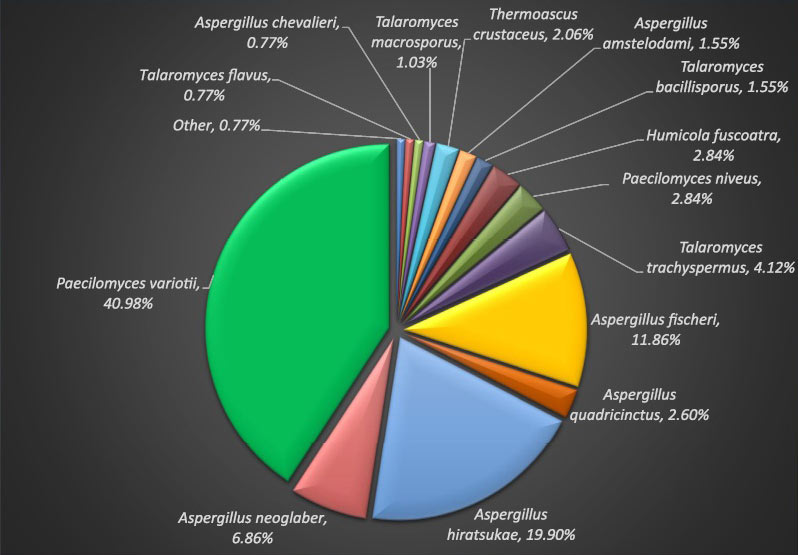
The genera most frequently isolated from spoiled products include Paecilomyces, Aspergillus, and Talaromyces.
Dormant ascospores require a “trigger” such as heating (e.g., pasteurization, hot filling) or high pressure to be activated.
Once activated, if conditions are favorable, they can germinate and begin to grow.

These spores can germinate and form biofilms, which are communities of microorganisms enclosed within a protective matrix.
Biofilms can further increase the heat resistance of ascospores.
In fact, studies have shown that within biofilms, they can be more heat-resistant than individual spores.
This is because the biofilm matrix can protect the spores from heat damage.
Some HRMs are capable of producing various mycotoxins (e.g. , patulin, ochratoxin A), which pose a risk to human health.
Mycotoxins are almost all cytotoxic, causing damage to various cellular structures and interfering with important cellular processes such as DNA and RNA synthesis.
Certain chronic and acute diseases in humans and animals have been linked to mycotoxin contamination in food.
2. Heat-Sensitive Molds (HSM) and Yeasts – Post-Process Contamination
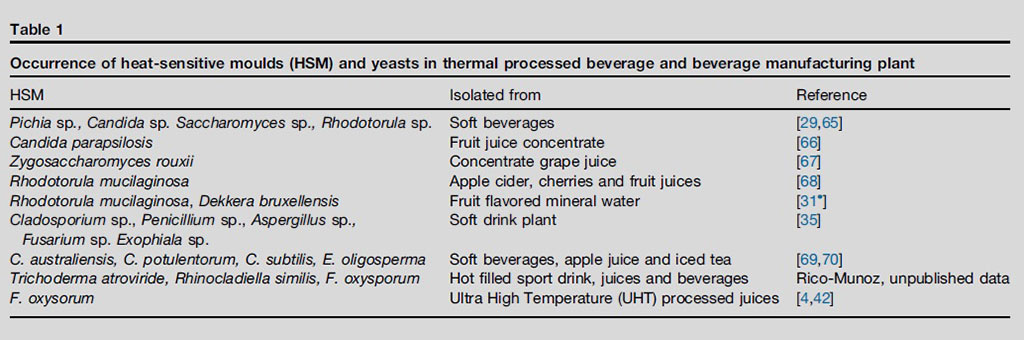
Unlike HRMs, HSMs and yeasts are generally destroyed by standard pasteurization processes.
Therefore, the spoilage caused by these microorganisms is mostly due to post-contamination or cross-contamination that occurs after the initial heat treatment.
These organisms can be introduced into processing facilities through ingredients, air, water, and packaging.
Where does the contamination in beverages come from?
Sources of contamination for HRM:
HRM ascospores are widely found in ingredients (both liquid and dry, such as sweeteners, juice concentrates, pectin, etc.), in packaging (empty PET bottles, cartons), and in the processing environment.
They are widespread in the soil, especially in cultivated fields, contaminating fruits and vegetables.
In the production environment, areas such as bottle receiving (depalletizers, palletizers), wooden pallets, slip sheets, air conveyors, conveyor belts, and forklifts/pallet jacks are particularly prone to issues.
The ascospores on these surfaces can easily become airborne and contaminate other surfaces, the inside of bottles, and the opened product.
Sources of contamination for HSM and yeasts
HSM and yeast are also delivered via raw materials, ingredients, air, and packaging.
However, a specific source of concern for these groups is the surfaces of equipment and the biofilms that form on them.
Air and water act as vectors for the spread of these fungal species.
How to Combat Contamination: The Role of Biofilms
This is where a crucial factor comes into play—especially for HSM and yeasts—which has been the focus of this article: the biofilm.
According to sources, eradicating some of these microorganisms (HSM and yeasts) from equipment is a major challenge because they are involved in biofilm formation.
A biofilm is a community of microorganisms (in this case, fungi and yeasts) attached to a surface and embedded in a self-produced protective matrix.
This structure provides them with protection, particularly against the effects of sanitizers.
The presence of HSM and yeast poses a difficult problem precisely because they are involved in the formation of biofilms that protect them from sanitizers.
While HRM ascospores are inherently heat-resistant, the main challenge lies in their physical removal and chemical inactivation from sources of contamination; for HSM and yeasts, the challenge is to prevent post-contamination and, once they have established themselves on surfaces, to remove the sanitizer-resistant biofilms they form.
Beverages: Strategies for Preventing Contamination
Preventing spoilage requires different approaches for HRM and HSM/yeasts:
Prevention of HRM Contamination
This requires reducing or eliminating ascospores from ingredients, packaging, and the environment. Key actions include:
- Regular monitoring of ingredients, the environment, and packaging.
- Maintain positive air pressure in the filling room, ideally with HEPA filtration.
- Properly handle wooden pallets and forklifts/pallet jacks to prevent the spread of ascospores.
- Avoid using air-blowing systems near open containers; use vacuum systems instead. o Use the appropriate sanitizers at effective concentrations.
Prevention of Contamination by HSM and Yeast
This requires the elimination of contamination from packaging, equipment, and the environment. Key actions include:
- Monitoring of the environment, packaging, equipment, and cooling water. o Maintain positive air pressure and filter the air in wet processing areas.
- Implement a robust sanitation program to prevent the buildup of HSM and yeast on surfaces.
- Use sanitizers at the appropriate concentrations and in sufficient quantities.
- Manage the cooling water by maintaining the pH to ensure the effectiveness of the chlorine.
- Consider fogging with disinfectants in smaller areas to reduce the concentration of airborne spores.
- Have a biofilm removal program in place. Preventing biofilm buildup is essential.
Preventing Contamination in Beverages: Conclusions
The issue of yeast and mold contamination in heat-treated beverages is complex.
For HRMs, the challenge lies in the survival of their ascospores in high temperatures and their widespread presence in sources of contamination.
For HSM and yeast, the main problem is post-contamination and, above all, the formation of resistant biofilms on equipment.
Preventing deterioration requires strict control of sources of contamination for HRMs and the implementation of robust sanitation programs, including the management and removal of biofilms.
In this context, Biorem® offers an effective and definitive solution for removing biofilm and preventing its formation, whether in closed systems or on open surfaces.
The unique, eight-component enzyme blend in Biorem® 3G—the only one of its kind on the market—is effective against any type of biofilm, regardless of the microbial population inhabiting it.
https://www.piramide-ambiente.it/prodotti-enzimatici/rimozione-biofilm/
Our expert microbiologists and Biorem® treatment specialists are available to discuss this topic in greater detail.
Bibliographic sources
- The fungal problem in thermally processed beverages; E. Muñoz et al. Food Science 2019, 29:80–87
- Heat-resistant molds: Assessment, prevention, and their implications for food safety and public health; Beyza Hatice Ulusoy et al. Czech Journal of Food Sciences, 40, 2022 (4): 273–280
- Heat-resistant ascospores; Jan Dijksterhuis, Applied and Industrial Mycology, CBS Fungal Biodiversity Centre, Uppsalalaan 8, 3584 CT, Utrecht, The Netherlands