Characterization Approaches and Implications for Product Safety
Although beer production is intrinsically linked to the microbial activity of brewer’s yeast, it is constantly threatened by the unwanted growth of contaminating microorganisms.
Such contamination can occur at various stages of the process, but nearly half of all contamination incidents in the brewing industry are attributed to the final stages, particularly the filling area (bottling, canning, or kegging).
It is during these critical stages that biofilms emerge as a key factor in the persistence of contamination. Despite the use of automated cleaning and disinfection strategies, such as Cleaning-in-Place (CIP) systems, microorganisms have developed survival mechanisms that allow them to withstand these procedures.
Understanding Biofilms: Structure and Formation
A biofilm is a community of microorganisms embedded in a matrix of extracellular polymeric substances (EPS) that they produce themselves.
This matrix, which acts as a protective shield, enables microbes to withstand various stressful conditions, such as disinfection, UV radiation, and dehydration.
Biofilm formation is a gradual process:
- Initial Adhesion: The process begins with the adhesion of microorganisms to a surface, facilitated by the presence of a “conditioning film”—that is, organic substances (such as beer residues) that settle on the surface.
- EPS Production: After irreversible adhesion, microorganisms begin to secrete EPS, which, together with water and environmental debris, forms the biofilm matrix. EPS molecules are typically carbohydrates, extracellular DNA (eDNA), and proteins, but extracellular bacterial structures such as flagella, pili, and fimbriae also contribute to stabilizing the matrix.
- Maturation and Detachment: Within the biofilm, cells proliferate and the matrix thickens. The detachment of cells or clusters of cells from the mature biofilm is the final stage of the life cycle and represents the primary mechanism by which product contamination spreads in the food industry.
The beer paradox: an environment that is hostile to most unwanted microorganisms but vulnerable to biofilms.
Beer is inherently a hostile environment for most microorganisms due to its low pH, the concentration of hop bitterness, and its ethanol and CO2 content.
However, a limited number of spoilage bacteria and yeast species capable of thriving in beer can be found in the production environment. Common spoilage bacteria include genera such as Lactobacillus, Pediococcus, Pectinatus, and Megasphaera, while common spoilage yeasts include Saccharomyces and Dekkera. The most problematic beer spoilage organism is Lactobacillus brevis, known for its ability to form biofilms.
It has also been shown that diluted beer (e.g., with water) can promote greater biofilm formation than undiluted beer, likely due to the dilution of hostile compounds such as ethanol, CO2, and bitter acids from hops. Filling areas, where beer residues may be diluted with cleaning water, could therefore support biofilm formation by L. brevis.
The close relationship between biofilm formation and packaging lines
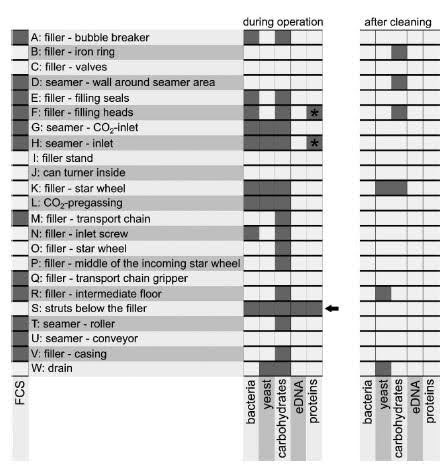
A recent study sought to characterize the microbial status and the presence of potential biofilms along a beer can filling line. During the study, 23 critical points (including food contact surfaces, FCS, and non-food contact surfaces, NFCS) were sampled at two distinct times: during operation and after cleaning and disinfection procedures.
The packaging line under study underwent an automated in-place cleaning (CIP) protocol, as well as the regular application of acid foam every 8 hours. In addition, manual cleaning was performed twice a week.
Microorganisms (bacteria and yeasts) were detected using real-time qPCR (quantitative polymerase chain reaction), a highly sensitive method for quantifying bacteria and yeasts. For biofilm detection, analysis of the components of the EPS matrix was performed: carbohydrates (determined using the phenol-sulfuric acid method), eDNA (precipitated and quantified spectrophotometrically), and proteins ( precipitated and analyzed by SDS-PAGE).
The study yielded a series of observations, summarized below:
- Presence of Microorganisms During Operation: During operation, nine sampling points (39%) were found to be contaminated with bacteria, with counts ranging from 0.39 log CFU/cm² to 6.19 log CFU/cm². At five of these points, yeast was also detected, with counts up to 7.36 log CFU/cm². All points investigated had higher microbial counts than the beer itself. Food contact surfaces (FCS) such as the bubble breaker (site A) and the filler gaskets (sites E, F) showed contamination, consistent with previous studies.
- Partial Effectiveness of Cleaning Procedures: After cleaning and disinfection, the presence of yeast was confirmed at three locations (13.01%), including two that had also tested positive during operation (star wheel and filling area). No bacterial DNA residues were detected after cleaning. However, at one site (site K: star wheel of the filler), the fungal load was actually higher after cleaning. This suggests that CIP may not significantly reduce microbial contamination in some cases, and may even promote the proliferation of certain species by reducing microbial competition.
- Identification of matrix components and biofilm hotspots:
- Detecting the components of the matrix is essential for distinguishing between adherent microorganisms and true biofilms. Carbohydrates, proteins, and eDNA were detected at 16 locations during operation and at four locations after cleaning and disinfection.
- Carbohydrates were detected at 16 locations during operation and at four locations after cleaning, indicating that cleaning strategies do not remove them completely.
- No eDNA or proteins were detected after cleaning and disinfection.
- Identification of a biofilm hotspot: The area beneath the filler (NFCS point) was identified as a potential biofilm hotspot. During production, this site exhibited a high bacterial load (6.19 log CFU/cm²) and yeast load (7.36 log CFU/cm²), and all tested EPS components (carbohydrates, proteins, eDNA) were present. Furthermore, the protein profile detected at this site differed from that of the beer, reinforcing the hypothesis of biofilm presence.
This study highlights the importance of considering biofilms as a persistent and significant source of contamination in beer filling lines.
- Ineffectiveness of conventional cleaning: Although cleaning procedures can reduce the microbial load, they are not always effective at completely removing all microorganisms—and, in particular, biofilms. The protective EPS matrix makes microorganisms in biofilms much more resistant to disinfectants and cleaning agents.
- Role of beer residues: Beer residues and other organic substances act as a “conditioning film” and can actively promote biofilm formation, especially when diluted.
- Non-food-contact surfaces (NFCS): The identification of the area below the packaging line as a biofilm hotspot demonstrates that even surfaces not in direct contact with the product can act as reservoirs of contamination and warrant special attention in hygiene strategies. Horizontal surfaces and bottling lines were found to be more susceptible to biofilm formation than vertical surfaces and packaging machines.
- The need for targeted approaches: Simply detecting microorganisms is not enough; analyzing matrix components (carbohydrates, eDNA, proteins) is crucial for identifying the actual presence of biofilms. Residues of matrix components can serve as a starting point for the development of new biofilms.
Control and Prevention Strategies
This study has provided a deeper understanding of biofilms and microorganisms present in beer-based beverage filling lines. For brewers, it is essential to develop strategies for the prevention and eradication of biofilms based on a thorough understanding of their composition and resistance mechanisms. This could include:
- the revision of CIP procedures to ensure more effective removal of organic residues
- the introduction of targeted protocols for biofilm removal
- the adoption of analytical methods for monitoring environmental hygiene that are based not only on the detection of potential contaminants, but also on the detection of organic traces
The decades of experience that Piramide and Realco have gained in the brewing industry have led to the identification of effective solutions for the issues mentioned above, ensuring that brewers achieve the maximum possible risk reduction while also providing solutions for the daily hygiene control of their facilities.
Enzybrew L represents a highly effective strategy for improving cleaning quality. The action of enzymes specifically designed for beer-related soiling, applicable both during soaking and in-process (CIP), ensures superior hydrolysis of beer residues and, consequently, improved hygiene.
Biorem®, a patent we have been applying in the brewing industry for many years, enables the hydrolysis of the biofilm matrix, resulting in its complete eradication.
Furthermore, the ability to perform microbiological analyses of the cleaning solution leads to a much deeper understanding of the machine’s hygiene status and any related issues.
Finally, thanks to our collaboration with our partner Sacco, Piramide is able to provide you with the best solutions for environmental hygiene monitoring, such as:
- Kit for detecting beer stains on surfaces and critical areas
- Kit for detecting organic residues on surfaces and critical points
- Bioluminescence meter for determining ATP levels on surfaces and in rinse water
All of this is backed by support from our technical staff.